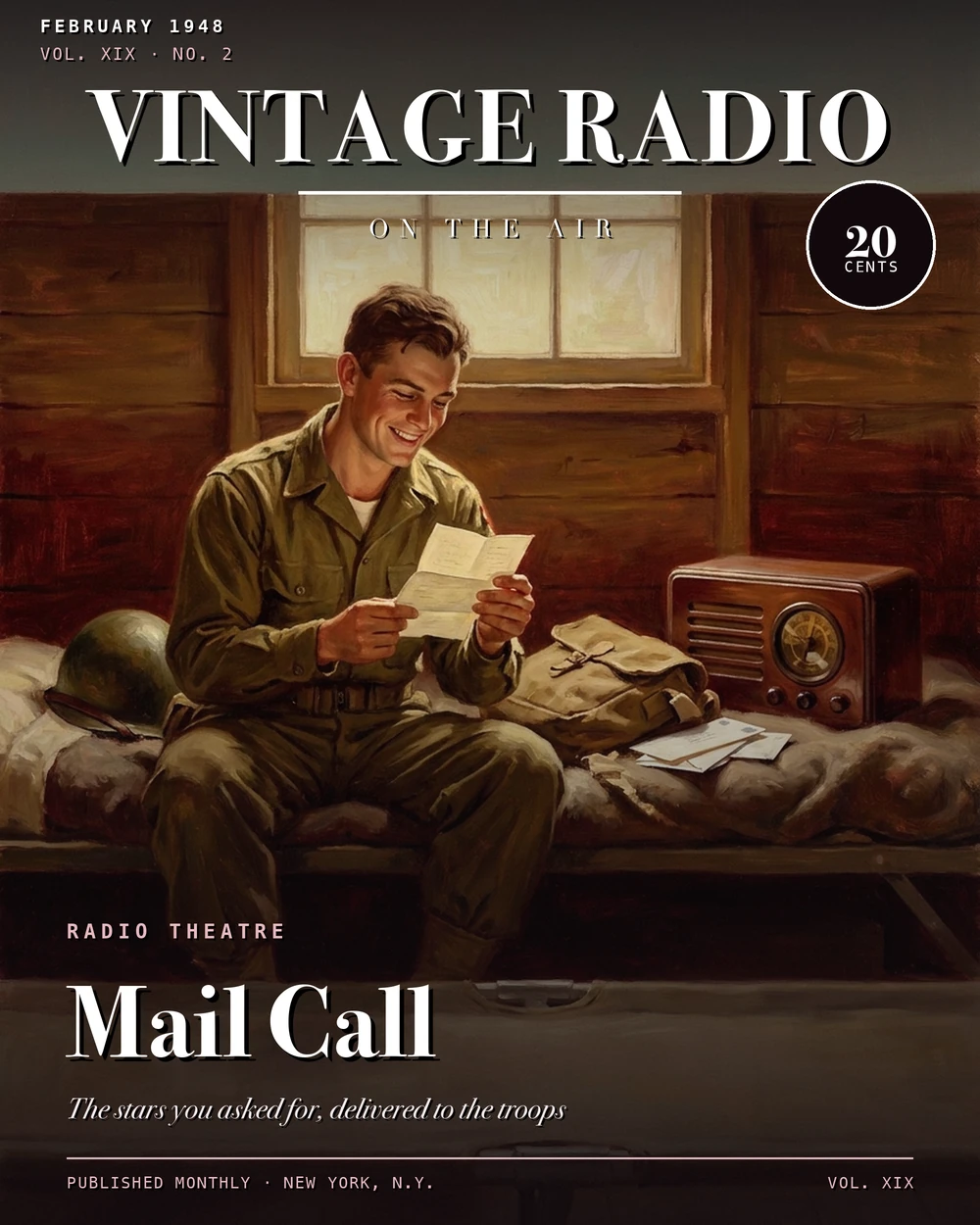
Mail Call
How It Got on the Air
Mail Call wasn't a network show, and it never ran for civilian listeners at home. It was created by and for the military — specifically, as one of the first productions of the Armed Forces Radio Service, which was formally established by War Department order on May 26, 1942. Mail Call premiered that August, making it part of the AFRS's founding slate of programming.
The driving idea was simple: let the troops ask for what they wanted to hear. Servicemen anywhere in the world could write to the AFRS at its headquarters on Santa Monica Boulevard in Los Angeles — chosen for its proximity to Hollywood — naming the stars they wanted on the air. The show would then deliver. As Lt. Col. Thomas A.H. Lewis, the AFRS commander, put it, Mail Call was "a morale-building half hour which brought famed performers to the microphone to sing and gag in the best American manner." Lewis brought real leverage to the job — he had been vice president at the Young & Rubicam advertising agency before taking the post, and was married to actress Loretta Young, connections that helped open doors to top Hollywood talent.
Each episode opened with the same signature introduction: "Mail Call from the United States of America. Stand by Americans. Here's Mail Call, one big package of words and music and laughter delivered to you by the stars from whom you want to hear..." That opening set the tone — this wasn't a polished commercial broadcast dressed up in khaki. It was a package sent from home, with a return address in Hollywood.
The Format and How It Worked
Mail Call's early format included a segment called "What's Going on at Home," paired with a clip from a current film. That structure was revised fairly quickly, and the show came to resemble its AFRS companion program Command Performance — a variety mix of music, comedy, and banter among performers. Britannica describes Mail Call and Command Performance as the "main AFRS series," calling them "virtually interchangeable" in their emphasis on music and comedy. The two programs ran in parallel, each drawing from the same deep well of Hollywood talent.
Every performer who appeared on Mail Call donated their services free of charge. There was no commercial sponsorship, no advertising rate card, no broadcast fee. The talent showed up because the troops asked for them, and because the war made it the thing to do. The show was distributed not over the airwaves but on 16-inch electrical transcription discs shipped to AFRS-affiliated stations around the world — shortwave transmission was too unreliable to carry a consistent signal to the European and Pacific theaters. Those discs went everywhere American forces were stationed.
The show's reach extended well beyond American troops. A July 1945 survey published in Broadcasting magazine found that 20 million British adults had recently listened to one or more AFRS programs rebroadcast in Britain. Mail Call specifically registered a listening percentage of 22.9 — a substantial audience for a show that had never been intended for civilian ears at all.
The Stars Who Showed Up
The roster of performers who appeared on Mail Call reads like a map of mid-1940s American entertainment. Bing Crosby turned up on multiple episodes, paired at various points with Dorothy Lamour, the Andrews Sisters, Betty Grable, and Connee Boswell. Jack Benny shared a microphone with Judy Garland; Frank Sinatra with Fred Allen; Danny Kaye with Ethel Smith; Dinah Shore with Jimmy Durante; Nelson Eddy with Burns and Allen; Kay Kyser with Georgia Gibbs; Lionel Barrymore with Eddie Cantor; and Norma Shearer also turned up alongside Georgia Gibbs.
Beyond that, the cast list keeps going: Bob Hope, Cass Daley, Paulette Goddard, W.C. Fields, Harpo and Groucho Marx, Claire Trevor, Tallulah Bankhead, Bette Davis, Betty Hutton, Ida Lupino, Virginia O'Brien, and others made appearances over the run. The familiar announcers — Ken Carpenter, Harry von Zell, and Don Wilson — gave the show additional continuity, their voices already recognizable to troops who had grown up listening to commercial radio at home.
The musical direction in the early period fell to Meredith Willson, then known as a conductor and composer, years before he would write The Music Man. Willson oversaw the AFRS orchestra and contributed to Mail Call and other high-profile AFRS productions during the service's formative period.
Why These Recordings Matter
Because the American Federation of Musicians' recording strike ran from 1942 through 1944, commercial recording activity was severely curtailed during those years. The AFRS, operating outside normal commercial frameworks, kept recording. That means Mail Call episodes capture world-class performers — Crosby, Sinatra, Benny, Durante, the Andrews Sisters — in live studio performances from a period when almost nothing else was being recorded. That historical gap makes these transcription disc recordings genuinely rare documents of American popular entertainment at a specific, otherwise sparsely documented moment.
The creative staff behind the scenes added another layer of significance. Among the AFRS sergeants working on the service's programming were Jerome Lawrence and Robert E. Lee, who would later co-write the Broadway productions Auntie Mame and Inherit the Wind. The AFRS was, in some respects, a wartime talent incubator — the kind of institution where people who would go on to shape American culture in peacetime were cutting their teeth on military broadcasting.
During at least one stretch in late 1944, production of Mail Call shifted temporarily to New York, a move reported in Billboard magazine on October 21, 1944, specifically to give troops exposure to "Eastern legit and night club talent" — performers whose home base was Broadway and the New York club circuit rather than Hollywood.
How It Ended
Mail Call outlasted the war it was made to serve. The show continued after the end of active combat in 1945 and kept running into the postwar period. Its end came not from a natural wind-down but from a budget cut. In 1950, the Secretary of Defense reduced the AFRS budget by $153,000, a cut that ended Mail Call along with eight other service radio shows that required outside talent. There was no farewell broadcast, no formal finale — just the budget line dropping to zero.
Within the AFRS family, Mail Call's counterparts and companions had included Command Performance, G.I. Journal, and Jubilee. Those programs, along with Mail Call, formed the core of what the AFRS offered troops during and after the war. Mail Call was the one that had been there from nearly the beginning, premiering in August 1942 as one of the AFRS's initial productions and running for the better part of eight years.
The 31 episodes held in this catalog represent a cross-section of the show across its run — enough to hear the format in action, the signature opening, and the parade of Hollywood names fulfilling requests sent in from the other side of the world.